
HCDE 517 · Usability Studies · 2026
Making medical information easier to share
Sponsor: UW Digital Initiatives Group
Usability studies help organizations understand how people actually experience a website, product, or service. By observing people as they use it, researchers can identify what works well, where people encounter difficulties, and opportunities to improve the experience.
In HCDE’s graduate Usability Studies course, students put these research methods into practice by partnering with organizations on real usability questions.
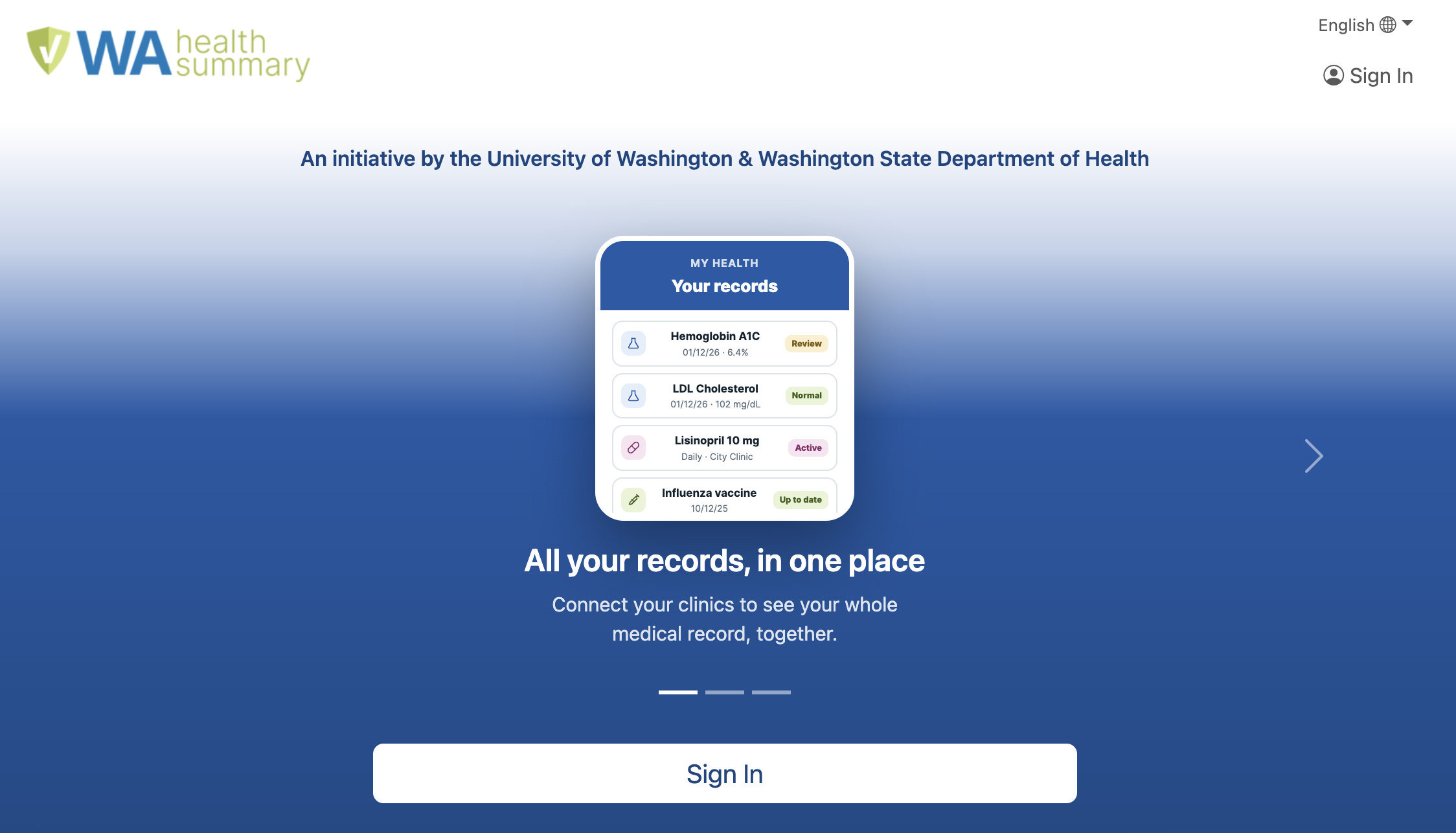
One recent partner was the Digital Initiatives Group (DIGI) at the University of Washington, which develops digital health solutions for public health programs and partners. DIGI partnered with HCDE master’s students Kazarina Liao, Melanie Song, Christine Tang, and Michelle Tran to evaluate WA Health Summary, a tool designed to help people bring together medical information from different health systems, create a customized health summary, and share it with others through a QR code or link.
HCDE master’s students evaluated a digital health tool for sharing medical information, identifying opportunities to make a complex health information workflow easier to understand and use.
The project at a glance
Partner: Digital Initiatives Group (DIGI), University of Washington
Focus: Usability of a medical information sharing workflow
Study participants: Five parents of young children and one older adult
Methods: Moderated usability testing with think-aloud, semi-structured interviews, and pre- and post-study surveys
Student deliverable: Findings and recommendations that informed the project’s next round of prototyping and design
What the students found
The team evaluated the application’s primary workflow, from importing health data and reviewing or editing information to creating a customized health summary and sharing it through a QR code or link.
Participants saw value in the overall concept of bringing health information from different providers into one place, and responded positively to the ability to import existing health records. The team also found that the QR-code sharing feature was generally intuitive, and participants felt they had control over what information they chose to share.
At the same time, the study revealed barriers that could make the experience more difficult. Participants struggled with unfamiliar medical terminology and unclear labels, while dense information and aspects of the navigation created cognitive overload.
The team recommended simplifying or explaining medical terminology, improving information hierarchy and labels, and making key actions easier to find. Their findings and recommendations directly informed the project’s next round of prototyping and design.
The findings directly informed the project’s next round of prototyping and design. After the course ended, members of the team continued working with DIGI through an HCDE Directed Research Group, extending a 10-week usability study into a longer-term collaboration.
What sponsorship looked like
- Up front: DIGI worked with the students to narrow a broad set of goals into a usability study that could be completed within the 10-week course.
- Access: The sponsor provided access to the application and project context and helped students understand relevant Washington State Department of Health guidelines.
- During the study: DIGI met with the team about once a week, provided feedback on research decisions, and helped communicate the value of the students’ human-centered design work to other project stakeholders.
- Recruitment: Students developed and carried out the recruitment plan, ultimately recruiting five parents of young children through word of mouth and one older adult through outreach to senior housing communities.
- Result: DIGI received findings and recommendations that informed the next iteration of the product, and members of the student team continued the collaboration through an HCDE Directed Research Group.
For DIGI, the usability study provided insight into how people understood and navigated a complex health information-sharing process. For the students, the project offered experience adapting usability research to the constraints of a real digital health project, from protecting participants’ health information to recruiting specific user populations and testing across devices.
It’s one example of how organizations can partner with HCDE students to better understand the people who use their products and services.
Partner with HCDE on a usability study
HCDE welcomes project proposals from industry, community, and academic partners for our Usability Studies course. Over 10 weeks, a team of 3–4 graduate students will plan and conduct a usability study and deliver findings and recommendations to your organization.
Projects run January–March, and there is no cost to participate. Sponsors provide access to the product or service being studied and help connect students with target users.
Learn more and propose a usability study