
HCDE capstone project sponsorship
The Department of Human Centered Design & Engineering (HCDE) welcomes project proposals from nonprofits, schools, government agencies, community organizations, and other mission-driven partners.
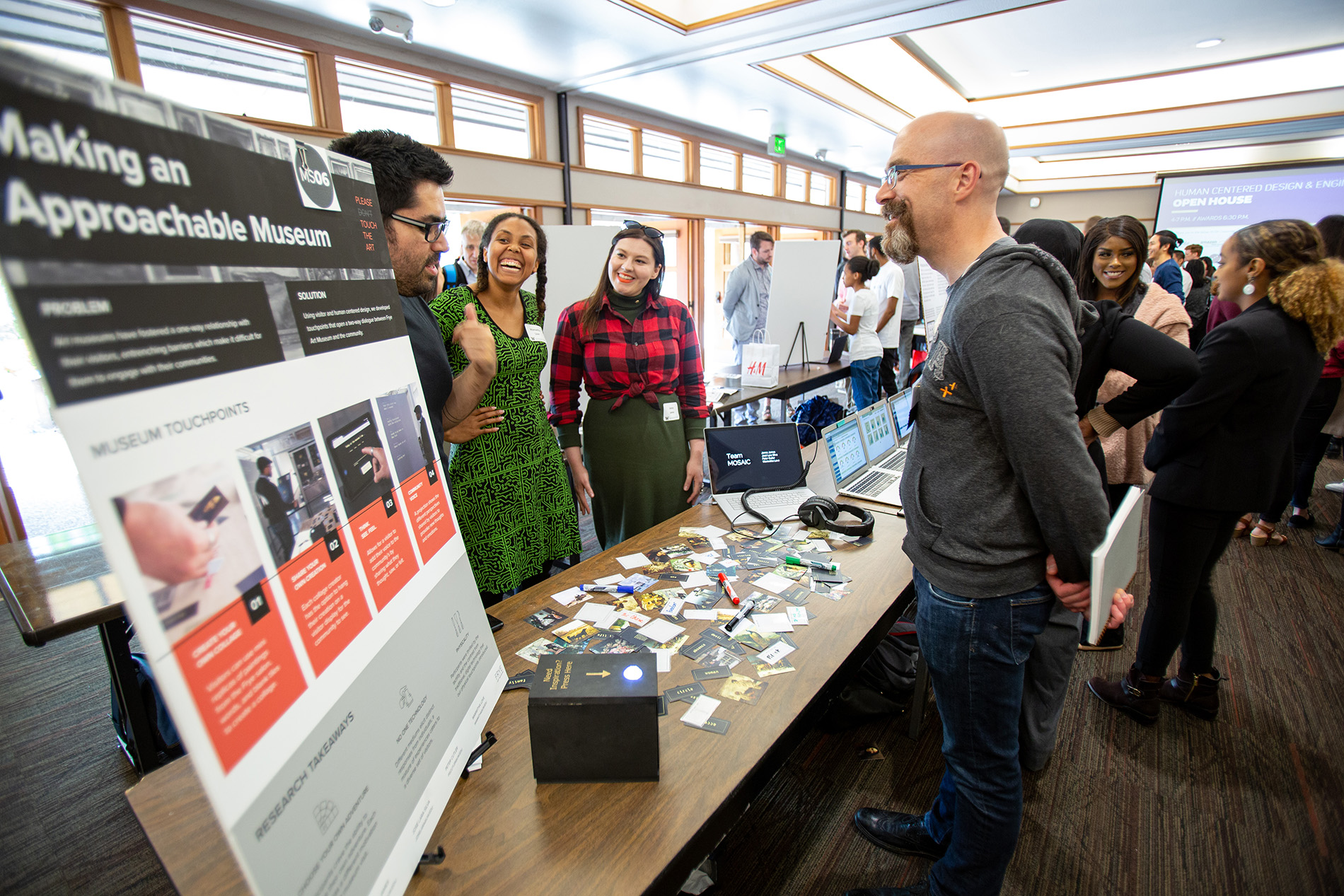
Capstone projects give student teams the opportunity to apply human-centered design and engineering methods to real-world challenges while providing organizations with thoughtful research, design insights, and new perspectives.
What is an HCDE capstone project?
Capstone projects are student-led, large-scale projects completed over two academic quarters. They serve as a culminating experience that brings together the skills students have developed across their degree program. Projects typically involve at least two components of the human-centered design process, such as:
- user research
- ideation
- prototyping
- evaluation
Depending on the project and team background, students may also engage in implementation. Projects can focus on research, service or system design, evaluation and testing, or early-stage concept development.
Benefits of sponsoring a project
Partner organizations often value capstone sponsorship as an opportunity to:
- receive hundreds of hours of focused student effort
- gain research findings and design recommendations
- explore new ideas or approaches
- build relationships with UW students and faculty
- contribute to student learning and community impact
What makes a good capstone project?
Strong capstone projects are:
- Broad in scope, allowing a small team to explore the topic over multiple months
- Grounded in real-world challenges relevant to your organization or community
- Important but not mission-critical or time-sensitive
- Well suited for exploration, research, or early design work
- Opportunities where a fresh perspective or additional capacity would be valuable
Projects that involve large amounts of confidential or proprietary information are generally not a good fit. If NDAs are required, please raise this early in the process.
Sponsor role and level of involvement
Capstone sponsors help shape the project area and support the student team throughout the process. Levels of involvement can vary.
At a minimum, sponsors may:
- propose the project topic
- share background information and organizational context
- attend the final Capstone Showcase presentation
Many sponsors also choose to:
- provide a mentor or point of contact who meets regularly with the team
- help connect students with potential users or study participants
- offer feedback on research findings or design concepts
Providing access to users or stakeholders is often one of the most valuable ways sponsors can support a project.
Timeline
Project proposal window: August – October 30
Final proposal deadline: November 15
Projects are reviewed by capstone instructors and assigned to either undergraduate or master’s cohorts based on best fit. Student project matching typically occurs in December or January.
Typical project timelines:
Master’s capstones: January – May
Bachelor’s capstones: Late February – May
Projects conclude with presentations at the annual HCDE Capstone Showcase in early June.
Important considerations
- Student work is their own and cannot be treated as contracted or proprietary work.
- Students must be able to present and discuss their projects publicly at the Capstone Showcase.
- Student grades are based on both individual contributions and team outcomes.
- Most projects do not require IRB review. If your organization requires IRB approval, please plan to apply in October or November and discuss this with the HCDE team early.