
By Jared Ren, HCDE master's student
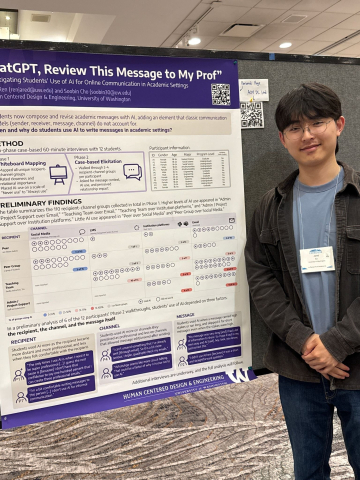
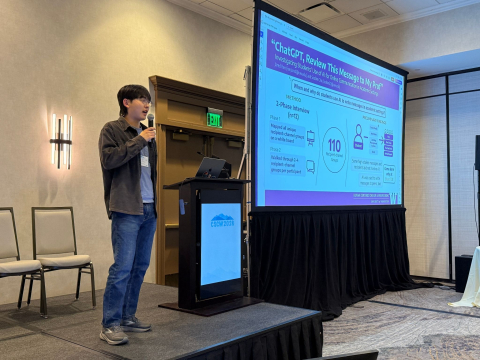
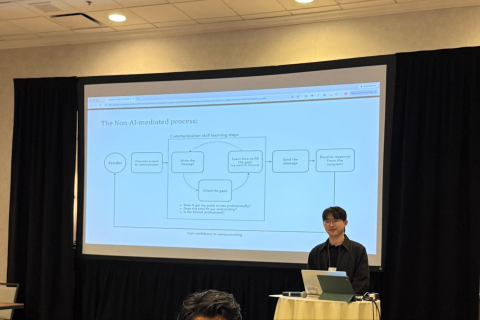
Thanks to the HCDE BS/MS Student Conference Fund and a UW Graduate School Conference Presentation Award, I spent October 10 to 14 in Salt Lake City at CSCW 2026, the ACM conference on computer-supported cooperative work and social computing. It was my first time presenting at a major conference, and I somehow ended up with three things to present. On Monday I gave a one-minute lightning talk and stood by our poster, "ChatGPT, Review This Message to My Prof": Investigating Students' Use of AI for Online Communication in Academic Settings, which I wrote with HCDE PhD student Soobin Cho. The weekend before the main conference I also presented a short paper at the Broader Impacts of Generative AI in Communication workshop and a position paper at the Nobody Did This workshop. The poster paper is now out in the CSCW '26 Companion proceedings.
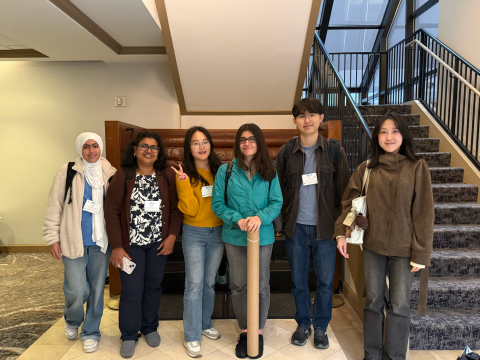
The poster session was the highlight of the week. The lightning talk got some laughs, mostly because everyone in the room recognized the behavior we studied, and that energy carried into the session itself. I had around fifteen conversations at the board in ninety minutes and many more in the hallways afterward. Every time I explained the study to someone new, the explanation got a little sharper. People asked hard questions, pointed me to papers I had not read, and offered different ways of thinking about the findings. It felt like a dozen reviewers had shown up in person to tell me what they would do next, and I am already folding that feedback into my follow-up work. The two workshops gave me something the poster could not, which was a full day of small-group discussion with people working on closely related questions. One participant gave me detailed advice on my workshop paper and another offered to mentor me going forward. Workshop lunches, the mentoring lunch, and dinners with PhD students from other programs turned into frank conversations about where my research is headed and how to approach PhD applications.
I came home with three things I did not have before. The first is confidence. After a week of explaining my own research to strangers, I trust that I can hold my own in the community I hope to join. The second is a clearer sense of direction. Conversations with faculty and PhD students helped me see which questions in my work on AI-mediated communication are worth carrying into the full-length extension of the poster study, and which programs and advisors fit that direction as I put together my PhD applications. The third is a community. I left with a mentor, a reading list, a group of peers I expect to keep running into at future conferences, and concrete feedback for my next projects. None of this would have happened without the HCDE BS/MS Student Conference Fund. For a master's student, the cost of a national conference is often the difference between presenting and staying home, and I am grateful to the donors who made this trip possible.
Photos:
With the poster at the CSCW 2026 poster session, Monday, October 12.
Giving the one-minute poster lightning talk.
Presenting the short paper at the Broader Impacts of Generative AI in Communication workshop.
With my mentoring lunch group.
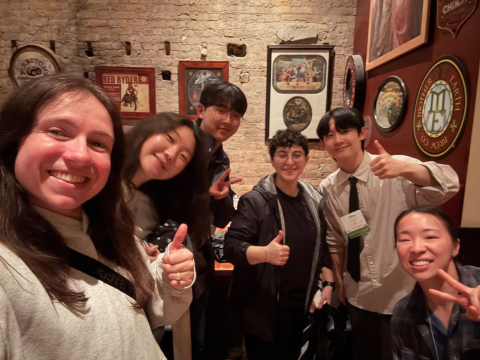
Dinner with PhD students from other programs.
Give to support HCDE student travel
The Mary B. Coney Endowed Fund, named in honor of Emeritus Professor Mary Coney, supports HCDE students by funding costs associated with travel to conferences and international workshops. Your support of this fund enriches the HCDE student experience and enhances HCDE's influence in the field.
Make a gift today