
This page contains an archive of the past five years of Directed Research Groups led by Professor Davidson.
Winter - Spring 2026
Rainier Valley Food Bank: Analyzing the Shopping Experience
Instructor: Andrew Davidson, Associate Teaching Professor Emeritus
OVERVIEW
In this DRG, we will explore the client shopping experience at a local food bank, using user research and prototyping techniques to make recommendations for how that experience could be optimized.
BACKGROUND
The Rainier Valley Food Bank, RVFB (rvfb.org), “is the primary emergency food resource for Seattle’s most racially, ethnically, and economically diverse neighborhood.” RVFB has just recently opened a brand new facility on their site in the Rainier Beach neighborhood of South Seattle. In this new facility, they provide a supermarket-like shopping experience for their clients.
RVFB would like to work with HCDE students to analyze the efficacy of the shopping experience, and learn how they might improve their services to clients.
DETAILS
Students will work RVFB staff to identify areas for change, suggest new designs or processes, and prototype their solutions. They will work in small teams to engage in user research, ideation, design, and prototyping/presenting solution concepts. Students will have access to the RVFB facility, and to various staff members to inform and guide their research.
After engaging in the research and design process, teams will develop prototypes or other effective methods of communicating their concepts, and will present these concepts to stakeholders at the end of the quarter.
Summer 2025
Rainier Valley Food Bank: Envisioning New Client Services
Instructor: Andrew Davidson, Associate Teaching Professor Emeritus
In this DRG, we will explore possible new services that the Rainier Valley Food Bank (RVFB) could offer its clients.
BACKGROUND
According to their website, RVFB (rvfb.org) “is the primary emergency food resource for Seattle’s most racially, ethnically, and economically diverse neighborhood and home to many people of color, immigrants, and refugees who regularly face systemic obstacles to living wage employment, affordable housing, and food security. It is home to a wide disparity of living standards where multi-million-dollar homes are down the street from Section Eight housing.
RVFB has bold ambitions to create a better future with food justice and equity at the center. Together we’re creating South Seattle's community food hub, redefining the role food bank’s play in our community as a driver of change, implementing a holistic approach to building secure, healthy, and thriving communities through equitable access to nourishing, culturally celebratory food.”
RVFB is launching a brand new facility on their site in Rainier Beach (Google Maps) this summer, renovating and expanding their former building. This renovation, in addition to improving the distribution of food to clients, will also allow them to grow and integrate the range of services they provide.
In this DRG, students will work with RVFB staff, clients, and stakeholders to envision possible new services they could offer in this dynamic facility.
DETAILS
Students will work in small teams to engage in user research, ideation, design, and prototyping/presenting concepts for new client services and how they could take advantage of the affordances in the new facility.
There are a wide range of possibilities for these services; RVFB is interested in understanding from user research what areas might be fruitful and valuable to their clients.
Students will have access to the RVFB facility, and to various staff members to inform and guide their research.
After engaging in the research and design process, teams will develop prototypes or other effective methods of communicating their concepts, and will present these concepts to stakeholders at the end of the quarter.
The DRG will meet once per week during the full summer quarter for approximately 2 hours, with meeting time TBD. Participants will earn 2 credits for the DRG. Outside of the designated DRG meeting, students will be expected to engage in fieldwork and other team activities.
Spring 2022
The Boys in the Boat: Reimagining the ASUW Shell House
- Andrew Davidson, Associate Teaching Professor, HCDE
- Kristine Matthews, Associate Professor, Visual Communication Design
- Plamena Milusheva, Physical Experience Designer
OVERVIEW
Watch the video above for a quick overview of the ASUW Shell House and restoration plan.
In this DRG, we will research, explore, design, and prototype concepts for interactive exhibits for the restored ASUW Shell House building.
BACKGROUND
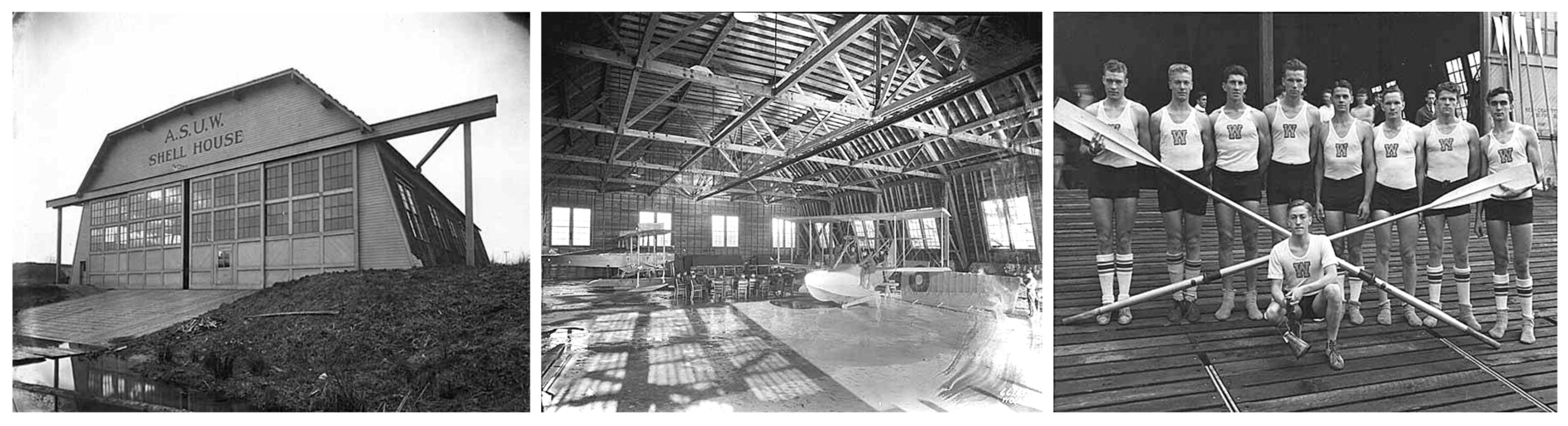
In 1936, the UW Rowing team took the gold medal at the Berlin Olympics, defeating the world’s best crew teams in a stunning victory in front of Adolf Hitler. This inspiring story was chronicled in Seattle author Daniel James Brown’s best-selling 2013 book “The Boys in the Boat.” For more details about the 1936 Olympic rowing event, check out this excellent 2017 PBS documentary: “The Boys of '36.”
The team’s home was an iconic building on the UW campus known as the ASUW Shell House (pictured above with the 1936 medalist team). This building, which had previously served as a US Navy hangar and training facility for seaplanes in World War I, dates from 1918 and still exists, but has been languishing unused for many years.
The UW has launched a capital campaign for the restoration of the Shell House with comprehensive plans for its new life: The Next 100 Years Campaign. In addition, a feature film adaptation of “The Boys in the Boat,” directed by George Clooney, is going into production soon.
The restoration planning team, led by campaign manager Nicole Klein, envisions the new Shell House building as a student space for meetings and classes, an event venue, and a cultural center, including historical exhibits.
It is the latter purpose that is the focus of our investigation -- exploring ideas and concepts for engaging interactive exhibits about the history and legacy of the ASUW Shell House.
DETAILS
Students will work in small multi-disciplinary teams to engage in user research, ideation, design, and prototyping of concepts for interactive exhibits that could be a part of the restored Shell House experience. These exhibits could range from permanent installations to temporary pop-ups that bring to life the history and engaging stories about the building.
There are many aspects of the Shell House site and building that could be explored, from the indigenous Native American significance of the site (before the ship canal was constructed), to the US Navy origins of the hangar, to the home of the UW crew teams and famed boat builder George Pocock, the role of women in rowing at the UW, and the ASUW period after the crew teams moved to their current home at Conibear Shellhouse.
Students will have access to the Shell House building, various stakeholders in the restoration, and experts on different aspects of the project.
After engaging in the research and design process, teams will develop prototypes of their concepts, and will present these concepts to stakeholders at the end of the quarter.
HOW TO APPLY
We are looking for dedicated and enthusiastic students at all levels (Bachelor to PhD) to work on this project. We are especially interested in having students from both HCDE and Design in the DRG in order to facilitate a rich cross-disciplinary collaboration.
HCDE applicants should be familiar with basic human-centered design processes, including user-centered design research, ideation, and prototyping. At a minimum, they must have taken HCDE 318 or HCDE 518.
Design applicants should be familiar with design-centered ideation, visualizations and research, and have an interest in storytelling that is integrated into 3d environments. Skills in 3d-modeling and/or material exploration are a plus but not required.