
Leah Pistorius
March 19, 2026
When Dr. Cecilia Aragon joined the University of Washington in 2010, data science was just beginning to gain wider public attention. Much of the conversation focused on the technical: algorithms, infrastructure, and scale. What was often missing, she recalls, was a deeper look at how people actually make sense of data and how human judgment shapes every stage of analysis.
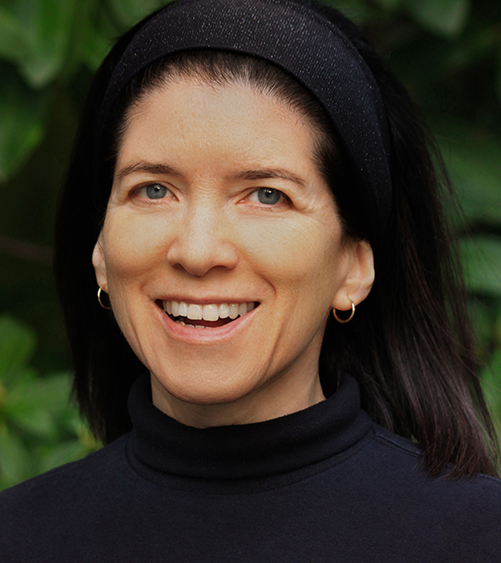
Cecilia Aragon is a Professor Emeritus in the University of Washington's Department of Human Centered Design & Engineering. Photo by Kathleen Atkins.
Over the next sixteen years in the Department of Human Centered Design & Engineering (HCDE), Professor Aragon helped define what is now known as human-centered data science, a field that explores the cognitive, social, and ethical dimensions of working with data. Through her research and mentorship, she helped position HCDE as a national leader in this area, influencing how scholars and practitioners think about data visualization, scientific collaboration, and human-AI interaction.
Aragon recently retired from her faculty role at HCDE. She describes retirement not as an ending, but as a new chapter focused on continued research, mentoring, and her work as CTO of the startup Viata.ai. In reflecting on her time at HCDE, Aragon discusses the evolution of her research, the growth of the field, and what she hopes students take with them into the future.
Building a field that didn’t exist yet
Before joining UW, Aragon worked as a computer scientist, data scientist, and software developer in industry and at national laboratories, including NASA and Berkeley Lab. While she enjoyed the technical challenges, she found herself drawn to questions that traditional computer science was not fully addressing.
“My PhD was at the intersection of data science, data visualization, HCI, and statistics,” she says. “I could see that the most important unsolved problems were not purely technical. They were human.”
When she entered the faculty job market, UW stood out immediately. “HCDE and the eScience Institute were the only places where I felt the full scope of my vision was understood and welcomed,” she says. “HCDE is a department that genuinely believes the ‘human’ part of human-computer interaction was central to the science, not secondary to it.”
The intellectual openness at UW allowed Aragon to develop what would become a defining contribution of her career. “Founding the field of human-centered data science is the accomplishment I’m most proud of,” she says. “It was not just one project. It was the long-term effort to show that a field like this needed to exist.”
Making the invisible visible in data science
A central theme of Aragon’s research has been the idea that data analysis is never purely objective.
“Data science had a blind spot about itself,” she explains. “It treated the analyst as invisible, like a neutral processor of information. But analysts are human. They bring assumptions, cognitive biases, collaborative dynamics, and social contexts to everything they do.”
With her students and collaborators, she studied how scientific teams build shared understanding around data, how visualization shapes interpretation, and how tools can better support human judgment instead of obscuring it. “These were questions that few traditional computer science departments were asking,” she says. “We were working in a space that genuinely needed to be carved out.”
As data science evolved alongside advances in artificial intelligence, the relevance of this work became even clearer. “My research has always focused on building a reflective layer into both data science and AI,” she says. “That includes studying how people make decisions under uncertainty and how technologies influence what we see as truth.”
Mentoring students to ask “who”
Aragon says HCDE students stand out for their comfort with complexity and ambiguity. “They understand that problems are both technical and human, and that you cannot fully solve one without attending to the other,” she says. “They are deeply curious about people, not just systems.”
In her courses and research mentorship, she often returns to a simple but important question: “I want students to ask who,” she says. “Who made this data? Who is missing from it? Who will be affected by the decisions it drives?”
Helping students develop a more critical and reflective approach to data and technology is central to her teaching. Visualization, she says, can make uncertainty appear more definitive than it really is, which makes ethical awareness especially important. “I hope students graduate from HCDE with confidence that a human-centered perspective is not a soft add-on to technical work,” she says. “It is essential to doing technical work well.”
Over the years, Aragon has been especially proud to mentor students who go on to integrate human-centered design and engineering into many different fields. One former PhD student once sent her a postcard that affirmed the kind of impact she hoped to have as an advisor. “They thanked me for modeling how to bring your whole self to your work,” she recalls. “They also shared that seeing someone build a full life outside of academia helped them believe they could do the same.”
Aragon says this perspective shapes how she supports students in building meaningful and balanced careers. She hopes to model that it is possible to pursue ambitious work while also having a full life outside of it. “I have hobbies. I’ve raised my children. I have had a husband of forty-one years. I’ve had a career I love,” she says. “I really feel like I’ve been able to have it all.”
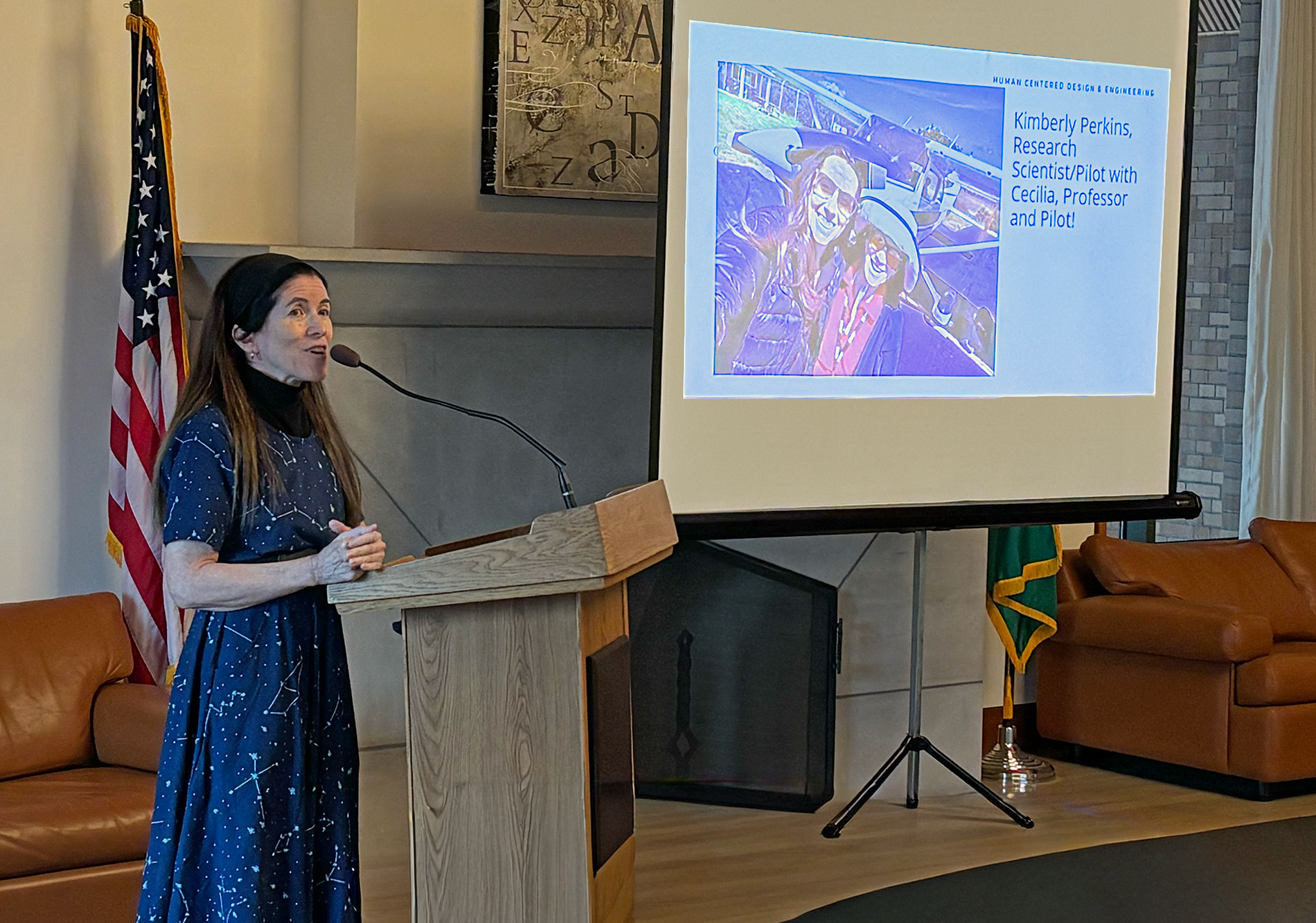
Professor Aragon addresses attendees at her HCDE retirement party on March 17, 2026.
A next chapter in applied work
While stepping away from her faculty role, Aragon plans to remain engaged in research and mentoring. She is also beginning a new phase of her career as CTO of Viata.ai, a startup focused on improving how people plan travel for events.
“We’re working to make the experience seamless and joyful for travelers,” she says. “It brings together data, personalization, and user experience in ways that feel like a natural extension of the work I have always cared about.”
For Aragon, the transition feels less like an ending and more like a continuation of the work she has been building throughout her career. “It’s not an end,” she says. “It’s the next arc.”
She remains committed to ensuring that AI technologies are used in ways that save people time, reduce burdensome tasks, and support positive human outcomes. “Every design decision is an ethical decision,” she says. “Engineers and designers are not just building systems. They are shaping how other humans experience the world.”
Looking ahead
Aragon hopes today’s HCDE students enter a field that is increasingly ready to hear human-centered perspectives, particularly as widely recognized challenges in AI and data practices have underscored the importance of trust, transparency, and inclusion. “I hope they seize that moment and lead with confidence,” she says.
Reflecting on her time at HCDE, she expresses deep gratitude for the intellectual trust she found in the department. “Sixteen years ago, I walked into a place that gave me room to pursue a research vision that didn’t fully exist yet,” she says. “Watching that field grow far beyond what any of us imagined has been one of the great joys of my professional life.”
She says her message to students and alumni is one of gratitude and encouragement. “You are the point of all of it. Thank you for bringing your whole selves into this work. I'll be watching what you do next, and I'm already proud of you.”