
Leah Pistorius
January 21, 2026
Kate Starbird, a professor in the University of Washington’s Department of Human Centered Design & Engineering, has been named a Fellow of the Association for Computing Machinery (ACM), one of the most prestigious honors in the computing profession. The ACM Fellow designation recognizes individuals whose work has made lasting, transformative contributions to computing through technical innovation and leadership.
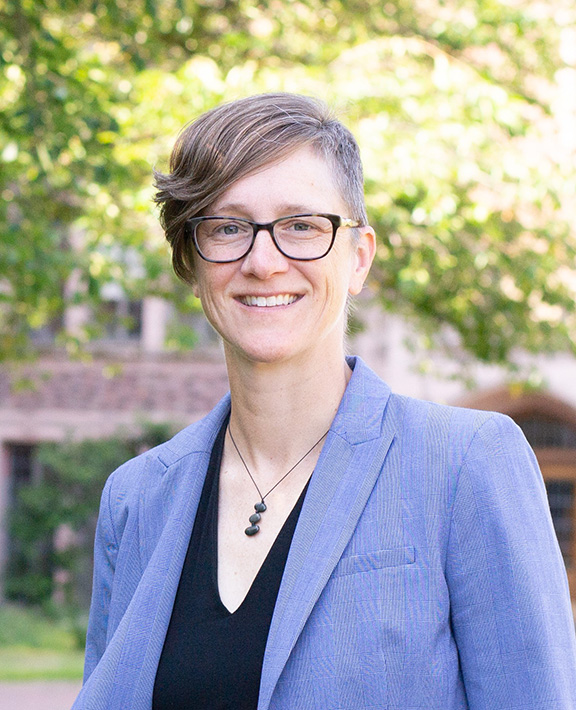
HCDE Professor Kate Starbird
Professor Starbird is internationally recognized for her research on misinformation, disinformation, and online information ecosystems. Her work has shaped how researchers, policymakers, journalists, and technology designers understand the spread of misleading information and rumors, particularly during moments of information overload that place public health and civic trust at risk.
The ACM Fellow program honors researchers whose influence extends beyond their home institutions, and Starbird’s research exemplifies this impact. Over the past decade, she has helped define a field at the intersection of human-computer interaction (HCI), computer-supported cooperative work (CSCW), and information science, bringing human-centered computing perspectives to some of society's most challenges.
From crisis informatics to the study of misinformation
Starbird’s research career began in crisis informatics, examining how people use technology to communicate, coordinate, and make sense of information during emergencies and mass disruption events. Earlier in her career, she studied social media activity surrounding events such as the 2010 Haiti earthquake, the Arab Spring, and the Boston Marathon bombing, exploring how information and rumors circulate when uncertainty is high.
At a time when large-scale social media data was only beginning to be studied, Starbird was among the first researchers to identify patterns in how misinformation and disinformation emerge and spread online. Her early work helped establish foundations for understanding how social media platforms shape collective sensemaking during crises.
Reframing how the field understands disinformation
Building on this foundation, Starbird’s research played an important role in uncovering and explaining organized misinformation campaigns during the 2016 and 2020 US elections. Her work demonstrated that disinformation is not just the result of bots or malicious actors acting in isolation, but a process involving coordinated networks, influential social media accounts, and ordinary users who may unknowingly amplify rumors and misleading information.
This reframing has influenced how researchers, policymakers, and technology companies approach the problem. By treating disinformation as a systemic phenomenon, Starbird has helped the conversation move beyond the idea that disinformation can be solved with a single technical fix, instead showing how it takes shape through human behavior, platform design, and government decisions.
One notable example of this is her collaboration on the Election Integrity Partnership, a cross-institutional effort to study election-related misinformation in real time during the 2020 US election. The project became a model for rapid-response research that connects academic expertise with public institutions and civil society organizations.
Leadership across research, policy, and professional communities
Starbird is one of the founding faculty members of the UW Center for an Informed Public (CIP), a cross-campus initiative that brings together researchers from engineering, information science, law, and related fields to study information ecosystems and strengthen democratic discourse.
Beyond UW, she has contributed to national and international efforts to address information integrity. Her service includes advisory roles with organizations such as the Electronic Privacy Information Center, the US Department of Homeland Security’s Cybersecurity and Infrastructure Security Agency, and the Aspen Commission on Information Disorder.
Within the computing research community, she has been a steady contributor to ACM SIGCHI through conference leadership, program committee service, and doctoral mentoring. Her scholarly record includes nearly 90 peer-reviewed publications, numerous best paper awards and nominations, and sustained influence across HCI, CSCW, and related fields. In 2025, she joined HCDE Professor and Chair Julie Kientz in being inducted into the ACM SIGCHI Academy, which recognizes leaders specifically in HCI research and practice.
Starbird’s election as an ACM Fellow recognizes her foundational contributions to computing’s understanding of misinformation and information ecosystems, work that has shaped research agendas, informed public discourse, and demonstrated the critical role of human-centered design and engineering in addressing complex societal challenges.